The Intelligence Part of Artificial Intelligence
How should we think about the "intelligence" the field of AI aims to build? Many popular answers, from Turing's Imitation Game to parity with the general capabilities displayed by the human mind, center on a notion of human resemblance. However, a more productive framing emerges when we look at intelligence itself (the "what"), rather than pursuing a perspective fixated on human intelligence (the "who"). Through example, I bring this view to life, taking inspiration from the inclusive spectrum of animal cognition and the pre-AI history of the mechanization of computing (formerly a human occupation).
In Search of Substance
We hear constant talk of artificial general intelligence and artificial superintelligence, despite a profound lack of clarity as to what the "intelligence" part actually means. Even the discourse of researchers can read more like marketing copy shilling "enterprise super-duper-intelligence" than discussion of a scientific agenda, at times veering into breathless prognostications that aim to push the very essence of humanity into irrelevance.
Beneath the noise, much of the confusion arises from a single habit: treating intelligence as an identity (a "who") rather than a capacity (a "what").Dungeons & Dragons figured this out a long time ago — intelligence goes in the stat section along with strength, dexterity, and charisma. It is not your character's race or class. Consider physical strength, a capacity enabling behaviors like picking up heavy objects. Though all humans possess some amount of physical strength, it isn't something that makes us uniquely human, and though there are animals and machines that can lift heavier objects than we can, there are numerous other applications that keep our human variety of strength competitively in demand. It may at first sound like quibbling over semantics, but thinking about intelligence analogously takes us further than you might imagine.
Science Has a Track Record of Disproving Our Special Identities
The past five centuries of scientific progress have forced humanity to give a lot of ground in the objective accounting of our centrality in the cosmos. From our place in the heavenly firmament to our place in nature, empirical evidence has time and again driven us away from explaining the world we inhabit in relation to us, pushing us to instead explain ourselves in relation to the world we inhabit. I am far from the first to draw a line between Copernicus and Darwin,In 1882, Professor Emil du Bois-Reymond of the University of Berlin gave a eulogy for Darwin titled "Darwin and Copernicus" drawing this very parallel (see pages 557-558 of Nature: A Weekly Journal of Science 27, no. 702 [PDF] if you're curious). Later, Sigmund Freud more famously echoed and extended the parallel in a series of lectures he gave from 1915 to 1917. In these lectures, Freud arrogantly asserted that the psychoanalytical theories he helped advance were "the third and most bitter blow" of the trifecta of "outrages" that humanity had thus far had to "endure from the hands of science." John Horgan's Scientific American blog post Copernicus, Darwin and Freud: A Tale of Science and Narcissism is a great read on the history here. but this connection extends squarely into the present-day study of intelligence.
The Cosmic Decentering of the 16th and 17th Centuries
Thus indeed, as though seated on a royal throne, the sun governs the family of planets revolving around it.
The Copernican Revolution saw an accumulation of astronomical observation that ultimately drove the proverbial final nail into the intellectual coffin of geocentrism. Nearly seventy years after Copernicus published On the Revolutions of the Heavenly Spheres, Galileo Galilei provided the first direct empirical evidence that planets orbit the sun: telescopic observations of the phases of Venus. As further evidence mounted over the ensuing century, no one of a scientific inclination could justify clinging to a geocentric model of the cosmos.Fun fact: Although Galileo's 1610 observations of the phases of Venus falsified the Ptolemaic model (everything orbits the Earth), they did not unseat Tycho Brahe's Tychonic system (a geocentrism-heliocentrism hybrid in which the planets orbit the Sun and the Sun orbits the Earth). Tychonic geo-heliocentrism was not fully discarded by scientists until James Bradley discovered stellar aberration in 1728, directly confirming the model of planetary motion developed by Kepler and Newton in the 17th century. It turned out that humanity had actually never held a special place among the stars.
Dethroning Homo Sapiens in the 19th Century
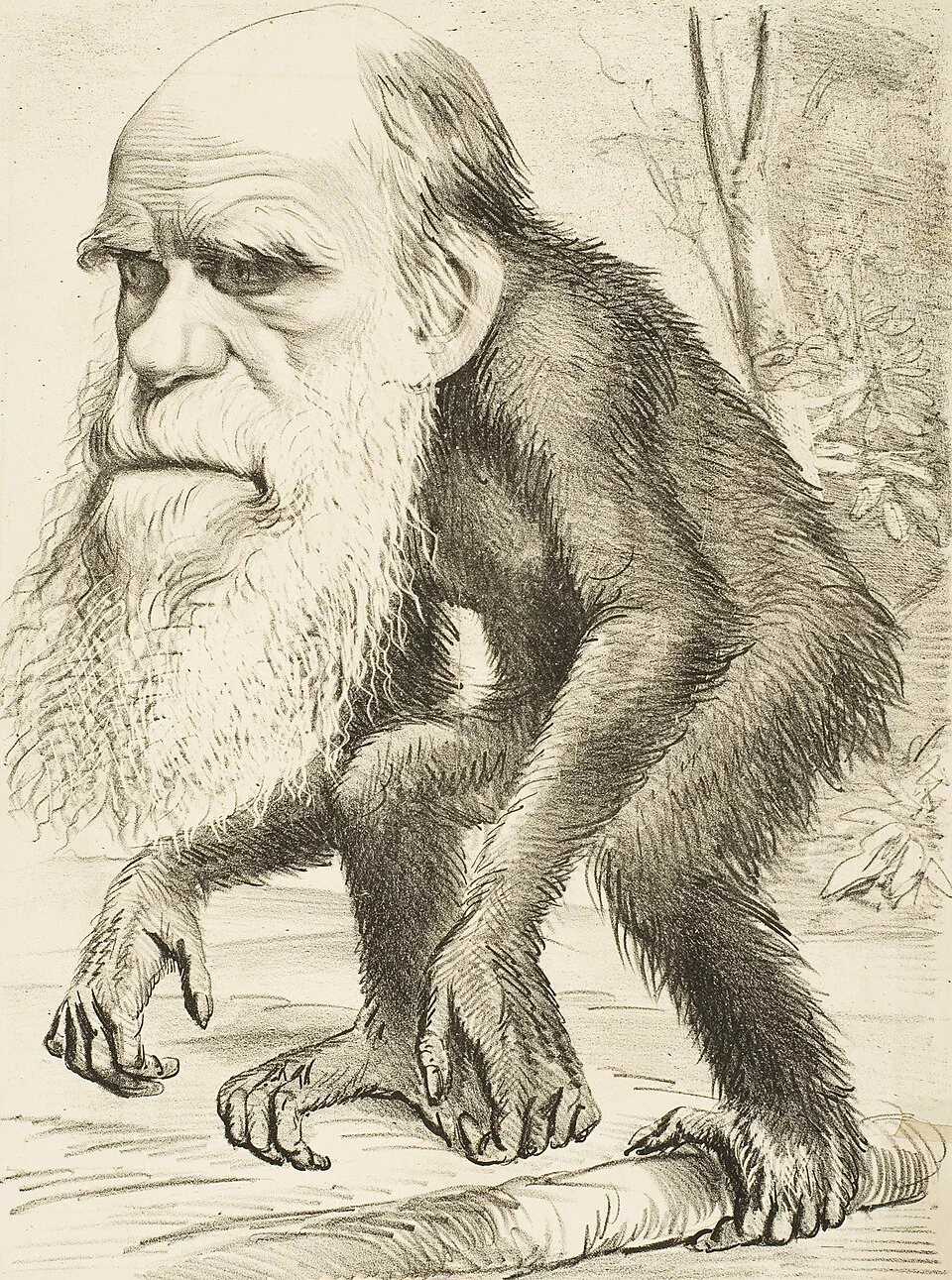
The difference in mind between man and the higher animals, great as it is, certainly is one of degree and not of kind.
Two centuries after Galileo's famous telescopic observations, Charles Darwin set out on the fateful survey expedition that germinated in him the idea of evolution through natural selection. By this time, astronomers had relegated Earth even further from cosmic centrality, with the sun itself now seen as just one star among countless others. Now it was the naturalists' turn to push us out of another one of our self-appointed VIP sections and into a biological general seating shared with the rest of the animals.
As Darwinism quickly took hold, humankind had to begin making do with emphasizing the degree of difference between humanity and the rest of the animal kingdom. Where before we had claimed a firm categorical difference between our species and other animals, we ceded this in the face of mounting biological evidence.Skimming through the original text of The Descent of Man, and Selection in Relation to Sex can be a great exercise in perspective. Much of what we take for granted today about the nature of nature was once a not-yet-settled argument. It turned out that humanity had actually never held a special place among the beasts, either.
Animal Cognition Illustrates a Spectrum of Intelligences
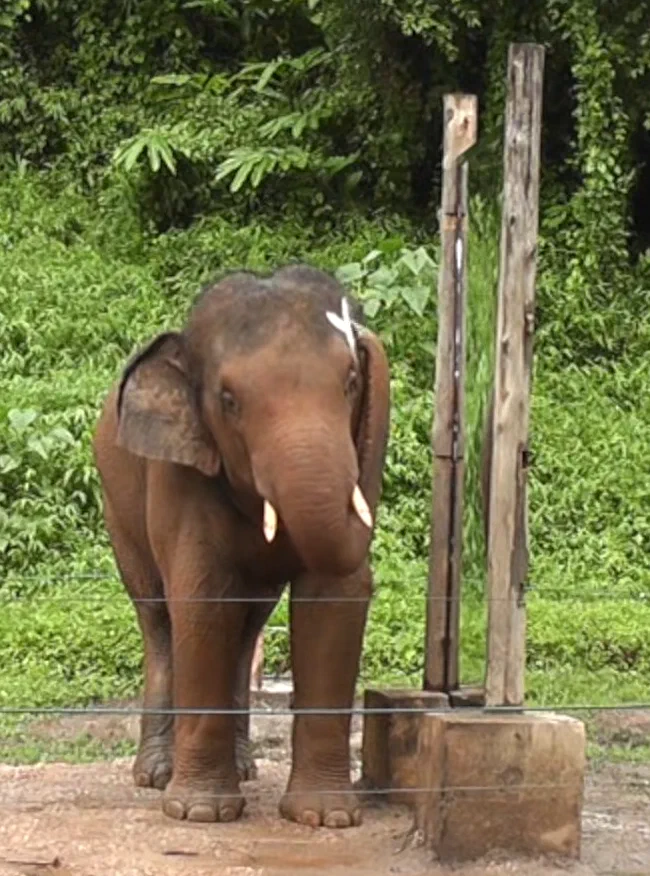
Since Darwin's time, progress in genetics and ethology has shrunk that remaining degree of difference considerably. "Animal cognition," once a laughable oxymoron, is now an active field of scientific research that has successfully contextualized human intelligence as a specific instance belonging to an overall spectrum. We now understand that humanity has actually never held a monopoly on capacities for learning, self-awareness, planning, tool use, theory of mind, and much else once thought to be uniquely ours.
To make these discoveries, we had to study cognition across species, an endeavor that by definition requires us to conceptualize intelligence by what it does rather than who has it. Biologist and ethologist Frans de Waal offers one such framing in his 2016 book Are We Smart Enough to Know How Smart Animals Are?: "Cognition is the mental transformation of sensory input into knowledge about the environment and the flexible application of this knowledge. While the term cognition refers to the process of doing this, intelligence refers more to the ability to do it successfully." In this view, we treat cognition as a strategy for filling an evolutionary niche, and intelligence not as a special human designation, but as a capacity for specific mental behaviors that enable survival.
Intelligences, Plural
I look at human cognition as a variety of animal cognition. It is not even clear how special ours is relative to a cognition distributed over eight independently moving arms, each with its own neural supply, or one that enables a flying organism to catch mobile prey by picking up the echoes of its own shrieks.
When we treat intelligence as a capacity and look to nature with that framing in mind, striking examples leap out in every direction. In addition to de Waal's examples of octopus and bat cognition, consider electroreception, the perception of electrical fields. Since the 1950s, we have understood this wondrous sensory capacity that is present in platypuses and many sharks but absent from primates like ourselves. Human intelligence, which evolved alongside our primate-typical palette of sensory input, is linked to our five-sense view of the world, and our particular smarts, general as they may be in certain arenas, do not encompass the capacity to process electrical stimulation conducted by water. A Gymnarchus niloticus fish, on the other hand, mentally transforms electroreceptive signals into a capacity to swim backwards around obstacles with the same adroitness as when it swims forward, demonstrating an altogether different form of intelligence from our own.
Another notable example is the African elephant, which possesses roughly three times as many neurons as we do. Scientists investigating the elephant brain have found that nearly 98% of its neurons sit in the cerebellum, leaving its cerebral cortex with only a third as many neurons as found in the human cerebral cortex. These scientists hypothesize that complex sensorimotor control of the trunk guided the evolution of the elephant's thinking apparatus toward such a distinct arrangement.The Elephant Brain in Numbers is a widely cited comparison of human and elephant neuroanatomy, and serves as my primary reference for why elephants have such large brains structured so differently from our own. The authors write: "We speculate that the extraordinary number of neurons in the elephant cerebellum, and thus the large absolute and relative size of this structure (Maseko et al., 2012) as well as brainstem motor specializations (Maseko et al., 2013b), may have been driven by the processing of complex sensory and motor information regarding the trunk, a large sensorimotor unpaired appendage unique to the Proboscideans." The trunk's-eye view of the world experienced through such a muscular, tactile appendage must yield a mental life starkly different from our own visual, five-fingered grasp of reality. To be sure, elephant intelligence enables a host of behaviors that feel unmistakably familiar to us, from rituals showing respect for the dead to the sophisticated exploitation of dozens of species of medicinal plants.The Elephant cognition Wikipedia article is a delightful overview of behaviors — from recreational play to rituals honoring the dead — that illustrate both stark similarities and differences between this fellow large-brained mammal and ourselves. For a deeper dive into our ever-growing understanding of elephant intelligence, the 2026 paper African elephants putatively self-medicate with medicinal plants in the Mount Elgon region, Kenya details the deliberate use of over thirty different kinds of plant medicine. One example in the paper caught my eye for the multi-step preparation involved: "In one such report from the WaTongwe ethnic group in Tanzania, an African elephant exhibiting symptoms of digestive discomfort was reported to crush leaves of the species Piliostigma thonningii, soak them in water sucked into their trunks, discard the leaves, and then drink the remaining water. It has been speculated that this behavior treats digestive problems in elephants. P. thonningii is used as a traditional medicine across Africa and its pharmacological properties are well-documented." Yet the brain and body underpinning these behaviors remain worlds apart from our own, suggesting plurality in even the most complex examples of natural intelligence.
Overcoming Intellectual Reluctance
It may appear that today's scientifically enlightened view of natural intelligence was an inevitable result of our learning ever more about the wonders of the world around us. However, the true historical record is more contentious than you might imagine. In Are We Smart Enough to Know How Smart Animals Are?, de Waal lays out the extensive history of psychologists underselling the intelligence of nonhuman animals: "For most of the last century, science was overly cautious and skeptical about the intelligence of animals... Students of animal behavior either didn't care about cognition or actively opposed the whole notion."
This excessive skepticism arose partly as an overcorrection to earlier misinterpretations of animal behavior. It is true that Clever Hans, a horse purportedly capable of arithmetic who was in fact responding to involuntary cues from his human questioners, fooled both the public and the scientific community. The backlash of skepticism went far overboard, however, into empirically unprovable (yet, as later work would prove, empirically false) claims that humans alone possess so-called "higher" mental faculties. Even in the case of Clever Hans, there was a missed insight arising from that persistent habit of treating intelligence as human similarity. Yes, Hans was incapable of arithmetic, but his uncanny sensitivity to human body language was an impressive capacity in its own right.
De Waal's writing abounds with vivid examples of undue skepticism incited by poor experimental methods (as well as poor experimental methods incited by undue skepticism). In one particularly telling case, after a mirror test study using a woefully undersized mirror failed to demonstrate self-recognition in elephants, much of the scientific community wielded these negative results as evidence that elephants lack this capacity. Given what we just discussed about elephants' large brains and sophisticated human-resembling behaviors, you might suspect that these creatures possess a capacity for self-awareness even if this experiment did not detect it. Perhaps those earlier doubters simply knew less about elephant minds than we do now, or perhaps they had buried their heads in the sand to protect fragile human egos. Whatever the cause, it took de Waal's collaborators repeating the experiment with an elephant-sized eight-foot-by-eight-foot mirror, enabling an Asian elephant named Happy to ultimately pass, to prove the widespread presuppositions wrong.The 2006 paper Self-recognition in an Asian elephant includes some delightful videos of the elephants studied. Previously published negative results include the 1989 paper Failure to Find Self-Recognition in Asian Elephants (Elephas maximus) in Contrast to Their Use of Mirror Cues to Discover Hidden Food, which concluded "Thus, despite their complicated uses of mirrored information, it is erroneous to conclude from the data presented here that elephants are capable of self-recognition. Instead, this work supports the view that repeated failures to find self-recognition in monkeys and many other animals is not because they lack the mechanistic skills for visually displaced reaching behavior."
The Intelligence of Computers
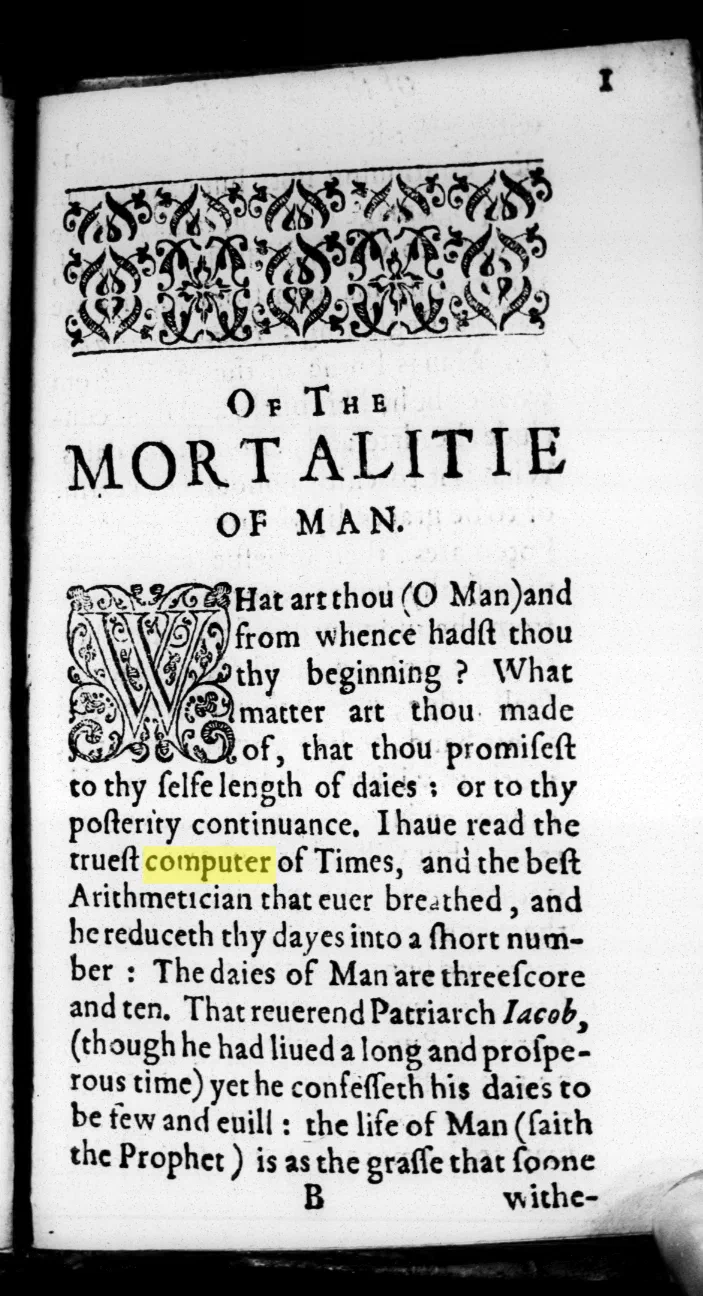
To humans alive in the 2020s, the word "computer" refers to a machine. In particular, we understand computers to be a type of machine that is electronic and digital in nature, typically assembled from integrated circuitry that we print directly onto wafers of silicon.
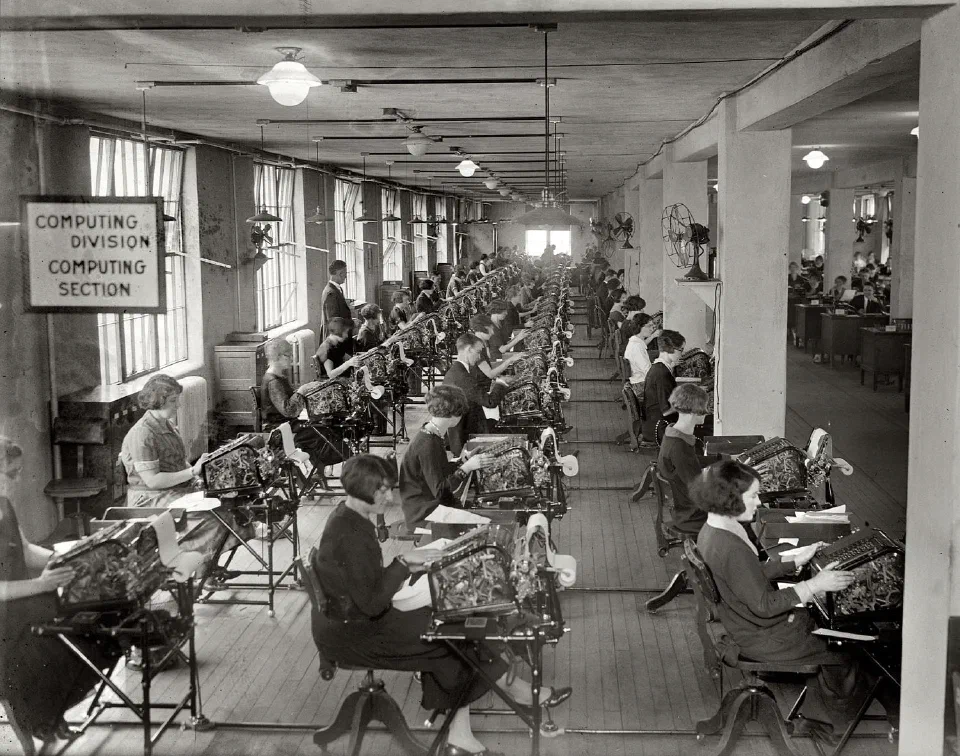
In contrast, to the humans of the 1920s, this modern definition would have elicited great confusion. To this cohort, computers did exist (the concept had been around for over 300 years at this pointSee the Computer_(occupation) Wikipedia page or the original source of the figure above.), but the term referred to people, not machines. Indeed, to compute was the labor of knowledge workers who carried out mathematical operations in service of scientific or engineering endeavors.
In the 1600s, computers aided astronomers in calculating the positions of planets. By the 1700s, governments had begun employing teams of computers for applications of national importance, such as deriving tables to aid maritime navigation. In the 1800s, computing grew in scale and standardization, with large teams hired to divide up batches of calculations in an early form of parallel processing.
One such team, the Harvard Computers, included some of the foremost women astronomers of the nineteenth and early twentieth centuries. Among them was Henrietta Swan Leavitt, a college-educated scientist who took one of the best jobs available to her at the time, that of being a computer. In this role, she extracted measurements from photographic plates and painstakingly executed calculations to determine the calibrated brightness and positions of stars for cataloging. Along the way, she discovered the eponymous Leavitt's law, a breakthrough enabling measurements of vastly larger astronomical distances than had been tenable previously.
Today, decades after automating computation, we tend to overlook its brilliance, treating it as a rote mechanical process akin to the turning of a waterwheel. Ironically, however, this human exceptionalism undermines the intellectual exceptionalism of humans like Leavitt, herself a career computer.
When we treat intelligence as a capacity not tied to any particular identity, we can instead appreciate the cognitive demands of computation the same way we appreciate the physical demands of manual labor. We acknowledge that plowing a field is demanding work whether done by a human, ox, or machine, and when we watch a gigantic combine tractor churn a cloud of dust as it harvests a sprawling field, we tend to marvel at its power rather than dismiss the task it performs. Making computer chips small and cheap likewise need not diminish the wonder of executing a billion error-free arithmetic operations in a second. Although machines now perform this work faster and better than humans, we can still consider it intelligent today for the same reasons we considered it so for hundreds of years before. To do so is freeing, even if it makes us feel a bit smaller.
Larry Tesler and the Tyranny of "Whatever Machines Haven't Done Yet"
Around 1970, Larry Tesler famously quipped that "Intelligence is whatever machines haven't done yet."Often misquoted as "Artificial Intelligence is whatever hasn't been done yet," Tesler clarifies on his personal website that his original words were about intelligence itself. He even goes so far as to explicitly draw a connection to animal cognition and human identity: "What I actually said was: 'Intelligence is whatever machines haven't done yet.' Many people define humanity partly by our allegedly unique intelligence. Whatever a machine—or an animal—can do must (those people say) be something other than intelligence." Just as de Waal and his primatologist peers found the goalposts of natural intelligence constantly shifted to stay one step ahead of their work studying nonhuman animals, Tesler and his fellow computer scientists noted a similar moving of goalposts whenever programmers produced mechanized solutions to cognitive tasks. This is just what happens when we mistakenly tie a class of capacities to our humanity — any instance of such a capacity outside of humanity forces us to redefine it out of the class. Today it is common to refer to this phenomenon as Tesler's Theorem or the "AI Effect," and we are presently celebrating over fifty years of its history.
If you look back far enough at the history of computer science, the mental gymnastics at play are impressive. In the latter half of the 20th century, software came to reliably solve many problems that once demanded human cognition. Between the basic arithmetic operations of digital computing and newfangled technologies like machine translation and automatic speech recognition familiar to the 21st-century reader, there exists a vast middle ground of oft-forgotten advances in mechanized intelligence. Yet the AI Effect is so strong that these advances appear downright pedestrian to modern sensibilities. For instance, even the humble symbolic integration capability that comes baked into a TI-89 Titanium calculator was an AI breakthrough when it was invented in the 1960s.The SAINT system for symbolic integration published in James Robert Slagle's PhD dissertation [PDF] is arguably the first expert system ever devised, pioneering this subfield of AI.
Tesler's Theorem is perhaps the most comically clear example of the limitations of defining artificial intelligence through human identity — it's downright self-defeating! Yet this AI Effect is just one instance of an old pattern, echoing the intellectual retreats that followed Copernicus and Darwin.
The pattern projects into the future, too, as we now encounter a peculiar forward-looking mutation of Tesler's Theorem in talk of an AI "frontier." This frontier refers to the set of capabilities most recently imbued into machines, sitting just across the border from "whatever machines haven't done yet." What makes this future-focused variation of the AI Effect so disquieting is that we often pair it with another anthropocentric habit: ranking intelligence along a single scalar axis that admits no niches or parallel tracks. It is no wonder this combination foments such psychic anguish — if we leave nowhere to hide but further up a single cosmic ladder, and we dismiss every capacity swallowed by mechanization as no longer special, our sense of human worth is doomed to drown beneath an ever-rising tide.
From Intelligence to Artificial Intelligence
One of the first computing researchers to ponder the automation of intelligent behavior was Alan Turing. In his landmark 1950 paper Computing Machinery and Intelligence, Turing productively moved away from the unanswerable question of "can machines think?" to a practical test of behavioral capacity, only to circle right back to human likeness as the yardstick by proposing his famous Imitation Game.
A few years later, John McCarthy coined the term "artificial intelligence" to accommodate several competing research agendas under a single 1956 summer workshop at Dartmouth.The Wikipedia page covering the 1956 Dartmouth Workshop is a fascinating look back in time. In contrast with the then-prominent field of cybernetics, which Norbert Wiener had named with a neologism and anchored to his own uncompromising vision, AI remained intentionally vague to straddle a broad span of ideas and egos (while skirting Wiener's). The term ultimately succeeded in bringing together biologically inspired neural networks, the symbolic logic of automata theory, and the probabilistic approaches of information theorists on even footing. The price for this inclusivity, however, was giving the nascent field a distinctly "in the eye of the beholder" flair.
This is not to say the original proposal for AI was lacking in concrete detail. McCarthy and collaborators put forth a bold conjecture "that every aspect of learning or any other feature of intelligence can in principle be so precisely described that a machine can be made to simulate it." They also specifically called for an attempt "to find how to make machines use language, form abstractions and concepts, solve kinds of problems now reserved for humans, and improve themselves."The full document is short and clearly written, so consider reading it in full. Ray Solomonoff's website hosts a lovely copy: the original proposal for the 1956 Dartmouth Summer Research Project on Artificial Intelligence [PDF].
Just as in Turing's 1950 paper, we see here both a focus on concrete capacity for useful behavior (solving problems, using language) and that ever-present impulse to define intelligence by human identity (as in "problems now reserved for humans"). The same mistakes made in biological science, the same regrettable forgetting that has taken the wonder out of computation, did creep into the field of AI at its founding. Yet at the same time, much of even the original AI research agenda appears more inspired by humanity than defined by it. Claude Shannon, a co-organizer of the 1956 Dartmouth Workshop, explicitly mentioned nonhuman animal intelligence in his contribution to the proposal, observing that "in general a machine or animal can only adapt to or operate in a limited class of environments." Additionally, Allen Newell and Herbert Simon's workshop submission cited "psychological experiments on human and animal learning" as inspiration for making machines behave like learning organisms.
We thus may concede that from Turing onward, the founders of AI crafted their vision of intelligence in their own image, continuing a precedent dating back to Aristotle's Scala Naturae, the ancient ladder linearly ranking the minds of living things from humans down to the plants. Or we may instead take the intentional and inclusive ambiguity of McCarthy's founding vision as an invitation to replace that ancient ladder with a branching array of inspirations, drawing upon whatever examples help us advance the field.
Rethinking Intelligence
What a bizarre animal we are that the only question we can ask in relation to our place in nature is "Mirror, mirror on the wall, who is the smartest of them all?" Keeping humans in their preferred spot on that absurd scale of the ancient Greeks has led to an obsession with semantics, definitions, and redefinitions, and — let's face it — the moving of goalposts.
So how should we think about the "intelligence" part of Artificial Intelligence?
When we let go of the idea that a universal big-I Intelligence is an exclusive part of our human identity, we set our minds free to think about what intelligence does and why. There are many fruitful places to look once we take up that refinement of the question. In nature, intelligence arose as a capacity for transforming information into useful behavior enabling specific species to succeed in specific ecological niches. In human technology, we advanced our civilization dramatically by mechanizing the cognitive labor of computing. Whether we draw inspiration from these examples or from somewhere else entirely, what matters is trading an anthropocentric, single-destination fixation on a fearsome AI singularity for a pluralistic, curious view. It is curiosity, after all, not fear, that feeds technological progress.
Of course, people still matter. We should seek neither to convince the chimpanzees to see us as special, nor to convince ourselves to view humanity as anything but. Curing our cosmic main-character syndrome, that impulse to place ourselves at the center of our objective accounting of reality, is not the same as diminishing the worth of humanity in the eyes of humanity. Human worth is ill captured by the scientific method, and that's okay, because we have far better tools for the job in the human-centric methods of art, philosophy, culture, and religion. These tools exist to deepen our understanding of the wondrous uniqueness of the human experience. To conscript astronomy, biology, evolutionary psychology, or computer science to the assignment of describing human value would be a misstep.
In fact, conscripting the study of intelligence to defend human specialness backfires, with laudable human achievement swept up in the blast radius of the AI Effect. Forgetting the importance and difficulty of computation pushes the skilled cognitive labor performed by human computers like Henrietta Swan Leavitt into the ignominy associated with monotonous menial labor, when her steady work charting the stars would be better honored if we stopped moving the goalposts.
Separating what humanity means to itself from the objective study of the world in which we live also frees us from self-defeating competition. We need not see chimpanzees beating us in working memory, oxen and combine tractors beating us at farm labor, or smartwatches beating us at arithmetic as challenges to our humanity. Darwin's revelation that man and ape descended from a shared ancestor, or the invention of digital computers capable of dramatically outpacing the human teams that preceded them — these shifts need not trespass into the territory of the sublime.
A dose of humble uncertainty is also in order, because we are still in the opening act of the AI age. In the span of a single century, "computer" went from naming a skilled human occupation to referring exclusively to machines, bridged by only a few decades of intermediate terminology like "electronic" or "digital" computers. Today we still use the qualifier "artificial" when speaking of intelligence demonstrated by machines, and we often question whether this is a stretch. History suggests bare "intelligence" could well broaden to encompass machines one day, or even come to refer primarily to them the way "computer" did, but if our shared sensibilities can swing so far in one direction, surely they can swing somewhere altogether different as well.
Still, we are already equipped to diagnose why Artificial General Intelligence and Artificial Superintelligence lack clarity in the common discourse. We act as though "general" and "super" are absolutes, while both are in fact relative. An intelligence is general only across a specific body of tasks, capacities, or environmental demands, and one intelligence lies "super" ("above") another only in relation to particular goals where it consistently delivers greater success. Since digital computers long ago achieved generality across multiple arithmetic operations (negation, addition, multiplication, and division) and supremacy over human intelligence in the speed and accuracy of these operations, we technically crossed the thresholds of AGI and ASI before we even invented the concepts.
The catch is that we built an AGI and an ASI — single instances out of many possibilities. Accepting the plurality of intelligence shifts the question from "are we there yet?" with AGI or ASI as a one-time milestone to a more helpful line of questioning: which AGI or ASI should we aim to build next? If crows and dogs both exist on the spectrum of intelligence, yet dogs make for better service animals, how can we artificially create something more like a dog's intelligence than a crow's? Or perhaps in settings that call for tool use or multi-step puzzle-solving, the opposite design inspiration will dominate.
Elephants, humans, and a few other species share a tendency to study themselves in the mirror. While this is a remarkable hallmark of self-awareness, when we are trying to understand intelligence itself, we must step away from the mirror to reach a better vantage point. After all, intelligence is not who you are. It's what you can do.